Central bankers and economic textbooks will have you believe that economic inflation is “an increase in the general price levels.” Due to inflation, your money is worth less than before—its purchasing power lower than it used to be. Capitalism, fall in supply, rise in demand, etc. are blamed. Everything but the main culprit is discussed. This is an instance of exclusionary detailing. Learn to see through the smoke and mirrors.
Think of other contexts in which the word is used. A balloon or a tire tube is inflated. Inflation of the universe followed the Big Bang. In each of these cases, ‘inflation’ is a volumetric concept.
This is no different in economics. Inflation refers to the increase in the volume of the money circulating in the economy. Why does this happen? Because governments spend more than they collect. This deficit is met by central banks manipulating numbers in their databases and creating new monetary units from thin air, thereby expanding money supply.
Now a consequence of this inflation is that price levels rise. To distract us from the core issue, central bankers and economists working for the government have in recent years redefined inflation as “price level rise.” So essentially an action has been redefined to refer to the outcome of that action, so that the cause of that outcome is obscured.
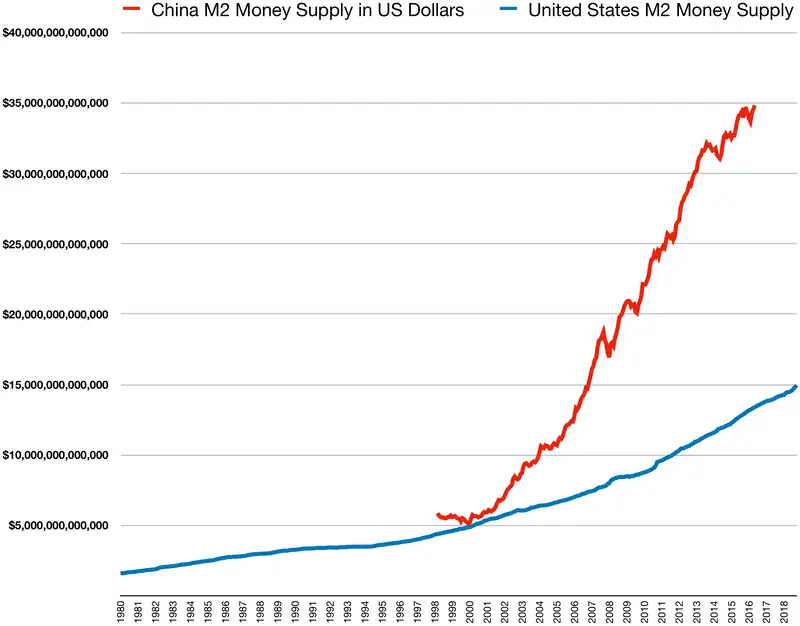 Expansion of M2 money supply, 1980-2018.
Image by Wikideas1 - Data: https://fred.stlouisfed.org/graph/?g=1ajW#0
Expansion of M2 money supply, 1980-2018.
Image by Wikideas1 - Data: https://fred.stlouisfed.org/graph/?g=1ajW#0